You already paid for the CDE. Now make it the way your projects actually run.
A 90-day implementation program for design offices using Autodesk Forma (formerly Autodesk Construction Cloud). We build the process, train your team, and hand over a simple before-and-after view your director will actually read.
From disconnected to in control
One trusted setup
Every project starts from the same clear baseline.
A process that holds
The platform supports the process, not one heroic person.
A simple ROI snapshot
Leadership gets a clear picture of change, adoption, and value.
Trusted by ambitious design and construction teams
Do uzupełnienia — 0 klientów programu, decyzja Ignacego
You know the symptoms long before anyone names the cause.
Nobody is certain which version is current. People ask a colleague instead of looking it up, because looking it up is not reliable.
The same drawing sits in five folders. Approval left no trace. Sooner or later a superseded revision reaches site, and the conversation that follows is not about software.
Every project is set up differently. A new project starts as an empty hub or a copy of someone’s old folder structure. Same firm, four conventions, four ways of naming things.
The rules hold only while one person polices them. That person is you. You chase people, clean up after other people’s deliveries, and explain the same thing for the fourth time this month.
Half of what you pay for is untouched. Reviews, transmittals, coordination — unused. What the firm actually bought is expensive storage.
What it costs before anyone puts a number on it
Rework nobody logs as rework. Hours spent finding, checking and re-issuing information that was already correct once. Deliveries sent back late because the entry gate is a person’s memory. Risk sitting in the gap between what your EIR says and what your projects do — the kind that surfaces during an audit or a client review, not on a normal Tuesday.
And one more, quieter cost. The role changes hands, and the next person starts from nothing. Three managers, three visions, three half-finished structures.
None of this is a software problem. Buy a better platform tomorrow and you will have every one of these back inside a quarter.
Four things changed at once.
The platform changed underneath you
The March 2026 rebrand to Autodesk Forma moved people onto a new naming, a new interface, and for many firms a migration off BIM 360. Practitioners are publicly asking Autodesk for a clear migration process. Whatever you do with the migration itself, it forces the same question: do we rebuild the same mess in a new place, or do we decide how information should move first?
Clients stopped asking politely
EIRs, ISO 19650 clauses and audit requirements now arrive as contract conditions. A standard that exists as a document and not as a practice does not survive contact with any of them.
The market is hiring for this problem
Design offices across the UK, Scandinavia and the Netherlands are recruiting Information Managers and Digital Delivery Leads, and the job adverts describe the broken process in plain language. Firms are trying to solve this by hiring. Hiring takes months and starts the learning curve again.
Waiting teaches the old way
Every month you wait teaches your team that the old way is faster. Habits harden. The next attempt is harder than this one.
And it is being solved.
Two things are worth knowing before you decide this is just how large design offices work.
The firms that get this right treat it as a change problem, not a configuration problem
Autodesk published a conference case study on a group rolling the platform out across four companies. Their own conclusion was that the hard part was the people — and that the gaps that hurt were training, communication and sponsor engagement, not features. A separate Autodesk implementation success story names the main challenge as providing a training programme for every stakeholder group.
These are Autodesk’s published cases, not ours. We point to them because they say, in the vendor’s own words, exactly where implementations succeed and fail.
The demand for the process layer has been visible for years
On Autodesk’s own ideas boards, the request to move approved documents properly through the workflow has been open since 2018 and has drawn around 100 votes. The request to get issue markups inside the system rather than in emailed PDFs has drawn nearly 700. Those are not niche complaints. They are thousands of people describing the absence of a process and hoping a feature will replace it.
It will not. But it does mean the problem you have is well-understood, widely shared, and has a known shape. That is what makes it addressable in 90 days.
You have probably tried at least one of these.
Here is why each one stops short.
| What firms try | What it delivers | Where it stops |
|---|---|---|
| More training from your reseller | A few hours on where to click, for a handful of users | Your people learn the buttons. Nobody decides what should happen, who owns it, or what a failed check means. |
| Writing the standard properly | A document, often a good one | A document is not a gate. Under deadline pressure the faster, familiar route wins, and the standard quietly stops being followed. |
| Hiring a freelance BIM Manager | Real expertise, by the day | The system lives in their head and leaves with them. Published UK day rates run £576–1,712. |
| An ISO 19650 course | Knowledge of the standard | Detached from the tool your projects actually run on. Nobody goes back and changes the process on Monday. |
| Switching platform | A new interface | Same governance gap, new logo, twelve months lost. |
| Making it one person’s job | Short-term control | Coordination on this scale is publicly described by practitioners as a full-time role in itself. When that person is on leave, the process is on leave. |
← scroll the table sideways
The gap nobody fills: Autodesk sells licences and does not provide implementation. Partners sell configuration and a few hours of training. Standards bodies sell knowledge of the standard, away from the tool. Nobody builds the process.
That gap is the entire product.
A 90-day implementation program for one company at a time.
Productised consulting — neither a course nor a done-for-you service.
First we help you decide how information should move through your projects: who owns what, what gets checked, what gets published, who is allowed to do what, and what happens when someone skips a step. Then we make Autodesk Forma enforce those decisions, and we train your people to keep it running after we leave.
Stage 1 — Audit
A structured questionnaire and an audit session, after purchase and before any work starts. You find out what you actually have, not what your standard says you have.
Output — your baseline, and the three largest gaps
Stage 2 — Implementation Plan
A personalised route from where you are to the target you agree, as a sequence of steps, with three pace options: aggressive, optimal, minimal. You choose the pace. We set the sequence.
Output — a plan with named owners and an order
Stage 3 — Implementation, with gates
You work through the steps using the templates and training materials. At each gate you submit an artefact and get an assessment and a correction back. Weekly Q&A sessions and a cohort of firms doing the same thing at the same time. This is the stage where “we wrote it down” stops being mistaken for “it works”.
Stage 4 — Measurement and the sponsor brief
Three layers: evidence of implementation, adoption signals from platform data, and an estimate of value.
Output on day 90 — a before-and-after comparison in numbers, and a one-page brief written for your director
Evolution, not revolution
Conventions dropped into the middle of a live project are the reason your team distrusts the last attempt. The sequence is designed so each step is survivable while projects are running.
The benefit has to be visible to one person, at their desk
Organisational arguments do not change behaviour. In our interviews, resistance and reversion to old habits was the single most frequently reported barrier — 11 of 20 people raised it without being asked. That is why change and adoption material is core to this program, not an add-on.
Eleven things, and none of them is a bonus.
- Audit of the current stateQuestionnaire plus an audit session, before work starts.
- A personalised Implementation PlanThe route from A to B, in sequence, with three pace options.
- Training materials on SkoolGovernance and decisions, not where to click.
- Templates and artefacts for every implementation stepYour team fills in a structure instead of inventing one under deadline.
- Change and adoption materialHow to talk to the team, how to reduce resistance, how to stop the quiet return to old habits, with internal communication templates.
- Weekly Q&A sessions and a participant communityOther firms at the same stage, in the same quarter.
- Quality gatesYou submit an artefact, you get an assessment and a correction.
- Measurement in three layersEvidence of implementation, adoption signals from platform data, an estimate of value.
- A before-and-after comparison on day 90, in numbers
- Sponsor-Ready Before/After BriefOne page for your director: baseline, the three largest gaps found in the audit, what was actually implemented, adoption signals from platform data, an estimated value or avoided cost, and the next three decisions that need a director to make them.
- Access for three people
Why the sponsor brief matters more than it looks. You do not hold the budget. If everything this program produces stays inside your team, nothing changes at the level where resourcing is decided. Every deliverable here is built so you have something to carry upstairs.
What this is not
- Not tool training. There is no “where to click in Forma” module, deliberately.
- We do not configure and administer your hub for you. You have to be able to run it after we leave.
- We do not fix the platform’s functional limits, its licensing model, or the quality of IFC exports from your authoring tools.
- Migration from BIM 360 is not part of the program.
- We do not do the work for you.
Your Tuesday, before and after.
You spent the day being the process
Someone messages you to ask which drawing is current. You check three places to be sure. A discipline lead has set up next month’s project their own way, and you find out when something breaks. A delivery arrives with placeholders and no metadata, and you fix it yourself because sending it back costs a conversation you do not have time for. Two people are marking up PDFs in email because it is faster than the system. At four o’clock you realise you have spent the day being the process.
None of it stops when you go on leave
The project was set up from a template in under an hour, by someone who is not you. The current version is where everyone expects it, and its status is visible without asking. The delivery that failed the entry check was returned automatically, with a reason attached, and nobody treated it as personal. You spent the morning on the standard itself rather than on enforcing it. When you go on leave next week, none of this stops.
What the firm gets out of it
Projects that start the same way and can be staffed across teams. Fewer arguments about which version was issued, and less of the rework that follows them. Evidence of ISO 19650 practice you can show a client instead of describing. A role that survives the person holding it. And, for the first time, a number to put next to the licence cost at renewal.
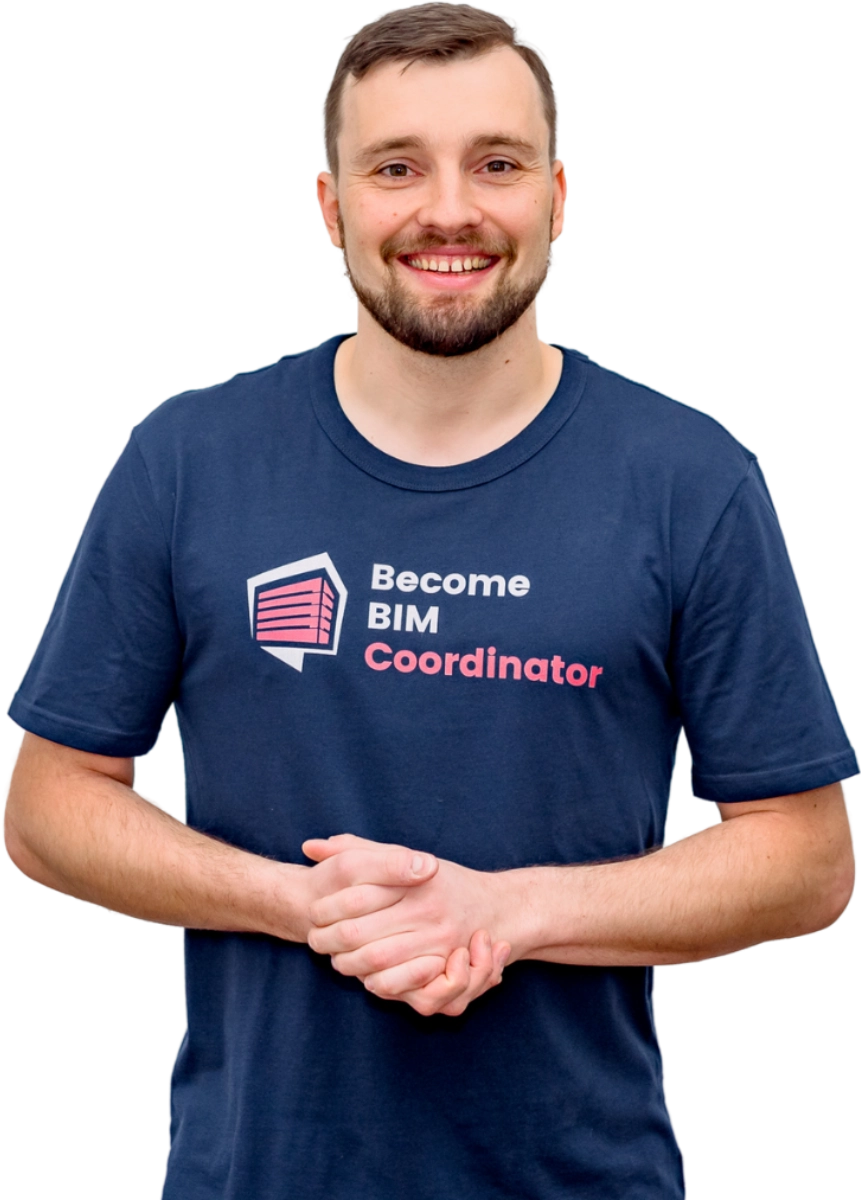
Ignacy Łoziński
Over a decade in AEC, most of it doing the job this program is about: BIM coordination and management on large, multi-party projects — Oslo Metro (Fornebubanen), Campus Ås, and Tønsberg Hospital, which won an award for its openBIM delivery. Before that, building a web platform for BIM data coordination, recognised with BIM Best Idea 2019 in Oslo.
Co-founder of BIM Corner, where a team of practitioners has published practical BIM knowledge since 2019. Author of Become BIM Coordinator, which has taken 750+ specialists through practical coordination across six editions since 2020.
Certified in openBIM and as an Information Management Practitioner. Works in English and Norwegian as well as Polish.
Where the program comes from. It started with 20 one-to-one interviews with BIM, information and digital managers, which produced 249 distinct problems. Those reduce to five clusters and six adoption barriers. The diagnosis above is their words, not mine — and if it read as though it was written about your firm, that is why.
There are no testimonials on this page.
This is the first cohort. There are no client case studies for this program yet, and there are no testimonials on this page because there is nothing honest to put there.
That is unusual for a page like this, so here is the reasoning. A program that promises before-and-after evidence cannot open by inventing it. Ten companies go through January 2027 at the lowest price this program will ever carry, and their results become the evidence the second cohort reads. That is the trade: you pay less, you go first, and the guarantee below exists precisely because you cannot check the results in advance.
What does exist: a decade of delivery on projects where this went wrong and had to be fixed, 750+ specialists trained, and 20 interviews that defined the problem before a single lesson was written.
Case studies and client results — added after the first cohort.
EUR 3,000 — 90 days, per company, up to three people.
- ExtensionEUR 500 per month, if you want the support to continue. Optional.
- No hidden costsNo per-seat fee, no separate audit fee, no charge for the templates or the sponsor brief. Everything above is included in the three thousand.
- Delivery90 days, counted from the end of the audit.
- CohortJanuary 2027. Ten companies.
- Payment termsDo uzupełnienia
- Enrolment closesDo uzupełnienia
Why this price, and why now. This is the first-cohort price and it rises in later cohorts. You are buying before there are published results, so the price reflects that. There are no discounts and no cut-down package: a cheaper tier would mean removing the audit, the quality gates or the measurement, and those are the parts that make this an implementation rather than a course.
What this costs against the alternatives
The comparison that matters is not the price of your licences. It is what an organisational implementation costs.
| What you could buy instead | Published price | What it covers |
|---|---|---|
| Remote readiness assessment, UK consultancy | around £1,495 + VAT | Assessment and action plan. Assessment only. |
| Assessment + roadmap + implementation support, same ladder | around £4,995 + VAT | Closest scope match on the UK market with a public price. |
| Autodesk CDE scoping and consulting, UK | £800–1,200 per day | EUR 3,000 buys two to three days. This program runs for 90. |
| Six hours of remote platform training, Australia | around A$3,000 | A few hours of tool training for up to eight people. |
| Autodesk Professional Services · large partner engagements | Not published | The closest substitutes to this program will not put a number on a page. |
← scroll the table sideways
This program is the assessment layer and the implementation layer, plus a 90-day sequence, templates, quality gates and before-and-after measurement — for less than the middle row.
Do uzupełnienia — verify all four published prices before publishing
The guarantee
If your company has completed every step of its Implementation Plan and passed the quality gates, and the final measurement at day 90 shows no improvement, the program is extended at no additional cost for up to a further 90 days.
The condition on your side is deliberate and it protects both of us. A firm that does nothing cannot expect a result, and a guarantee without that condition would be a promise I could not keep for everyone else.
What the guarantee is not. We do not promise hard-proven ROI inside 90 days. Nobody credibly can, and anyone who does is selling you a number they made up. We promise evidence that the system works, a credible estimate of value, and before-and-after figures you can put in front of your director.
What firms do at this point, and why it costs them.
Buying more training
The gap after purchase is not knowledge of the buttons. Every hour of tool training you buy without a process behind it teaches people to use a system nobody has decided how to run.
Writing the standard instead of building the process
A document with no gate behind it is a document. The test is simple: when did anyone last send a delivery back because it failed an entry check?
Rolling everything out at once, mid-project
Conventions dropped into a live project are why your team distrusts the last attempt. Sequence matters more than ambition.
Making it one person’s job
It works until that person takes leave, changes role, or leaves the firm. Then it does not work, and nothing they built is recoverable.
Deciding the platform is the problem
It is the easiest conclusion and the most expensive one. Switching costs you a year and gives you the same governance gap in a different interface.
Eight questions, answered straight.
“We already have our own standards.”
Most firms in this position do. The question is not whether the document exists — it is when someone last sent a delivery back because it failed an entry gate. If the answer is “never” or “we don’t have a gate”, you have a standard, not a process. This turns the first into the second.
“Our firm is too specific for an off-the-shelf framework.”
Fair, and usually based on real experience with a convention that was imposed at the wrong moment. You get a framework and templates, not a fixed standard. The Implementation Plan is built from your audit, and you choose the pace. The sequence is ours; the content is yours.
“Will this fix the things Forma can’t do?”
No, and we will tell you that on the fit call. Functional gaps, performance, the licensing model, IFC export quality from your authoring tools, and migration from BIM 360 are all outside the program. We build the process around the tool you have. If your main problem is one of those, this is the wrong purchase and we will say so.
“We don’t have time for another initiative.”
That is the real blocker, not an excuse, and it is why there are three pace options including a minimal one. The framework is built to take work off the overloaded person, not add to it. But if nobody in the firm has any reserved time at all, say so on the fit call — we will tell you honestly that this is not your quarter.
“People won’t use it anyway.”
The most common failure in the whole problem set, and the reason adoption material is core here rather than a bonus. Organisational arguments do not change behaviour; the benefit has to be visible to one person, at their desk, in their week. That is what the change module is about, and it is why quality gates exist. A rule nobody checks is a rule nobody follows.
“Our Autodesk partner already trains us.”
Partners are good at what they sell, which is configuration and a few hours of training. We do not compete with them and we will not touch your commercial relationship. We do the part they do not sell: the decisions, the process, the adoption, and the evidence.
“I’d have to justify this to my director.”
Assume you will — that assumption is designed into the product. The Sponsor-Ready Before/After Brief is one page in your director’s language: baseline, what changed, adoption signals, an estimate of value, and the next three decisions. And if you need something before you can even open the conversation, start with the free CDE ROI Audit.
“What if it doesn’t work?”
Then the guarantee applies: complete your plan, pass the gates, and if the day-90 measurement shows no improvement, you get up to another 90 days at no cost. What we will not do is promise you a proven ROI figure in 90 days. That number does not exist yet for anyone selling this, including the people who quote it.
The next step is not a purchase. It is a fit call.
We go through four questions about how information actually moves through your projects today. At the end, one of us says no. Most firms that book this call are not a fit, and finding that out in half an hour is cheaper for both of us than finding it out in month two.
You are a fit if
- You own your Autodesk Forma hub and bought it at least a year ago
- You run multiple parallel projects for different clients
- You are between 50 and 400 people
- There is a named person with reserved time to lead this
You are not a fit if
- You don’t have your own hub
- You need the platform’s functional limits fixed
- Nobody has any time reserved
- The decision sits outside your office
- You want training on where to click
Do uzupełnienia — calendar link Do uzupełnienia — CDE ROI Audit nie istnieje
If you take one thing from this page, take the test. Ask yourself when your firm last sent a delivery back because it failed an entry check. If nothing comes to mind, the standard your firm relies on is a document, and the process is a person — probably you.
That is fixable, and it is fixable in a quarter. The price for the first cohort is EUR 3,000 and it rises afterwards, so the cheapest this will ever be is now, while there are no case studies to show you. Complete the plan, pass the gates, and if day 90 shows nothing, you get another 90 days free.
Half an hour on a call is the whole commitment.